 EN
EN


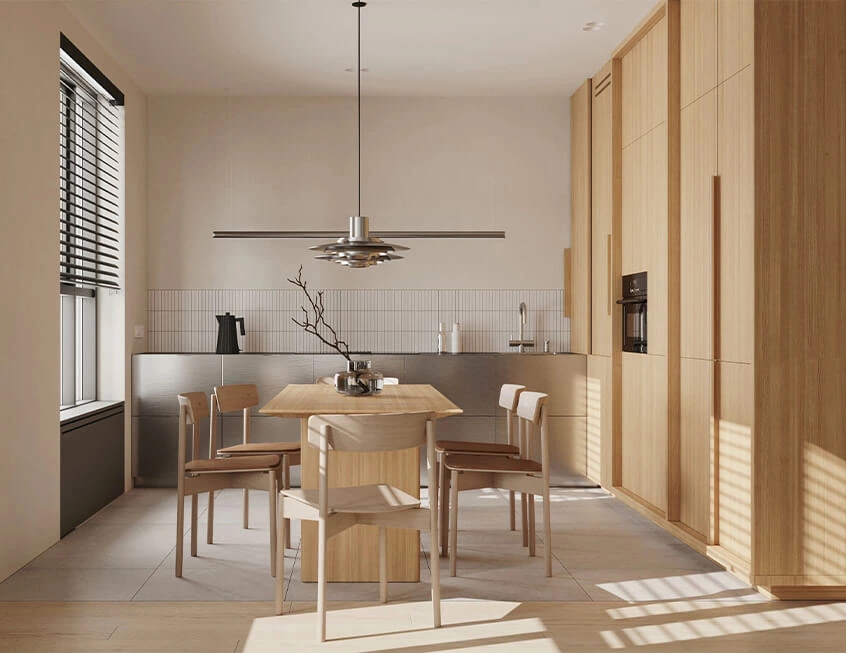
The Science Behind Texture: How Fine Surface Treatment Defines Premium Feel in High Quality Kitchen Cabinets
Why Texture Is the First Tactile Signal of Cabinet Quality
Human fingertips detect variations smaller than 1 micron—making texture the earliest and most intuitive indicator of cabinet quality. Finishes with inconsistent grooves exceeding 3µm depth register neurologically as “rough,” while uniform sub-micron patterns (<0.8µm spacing) elicit pleasant tactile responses. Leading manufacturers engineer surface structures with capillary networks calibrated at 25–40µm wavelength to optimize light diffusion and maintain friction coefficients between 0.15–0.25—the ideal range for tactile comfort. This dual-purpose design prevents smudges, resists fingerprints, and preserves aesthetic warmth—directly fulfilling the modern demand for functional luxury.
Micro-Level Uniformity and Controlled Light Diffusion: The Role of Surface Roughness (Ra <0.15 µm)
Achieving Ra values below 0.15 µm requires precision multi-stage polishing:
- Pre-treatment sanding at P800–P1500 grit
- Grain-filling with nano-silica compounds
- Non-shrink UV-LED curing at 405 nm
This process delivers 87% specular reflection (ASTM D523-14), essential for perceived depth—a key benchmark in premium cabinetry. Deviations beyond ±0.02 µm in Ra uniformity cause visible light scattering (Gloss Variation Index >5ΔGU per ASTM D2457), especially under 5000K daylight simulations where semi-gloss finishes (35–45 GU) dominate market preference. Such micro-level consistency also ensures dimensional stability under thermal cycling (EN 14923:2015), eliminating seasonal joint visibility while offering inherent scratch resistance through controlled nano-relief features that act as sacrificial micro-grooves.
| Measurement | Standard Value | Performance Impact |
|---|---|---|
| Roughness Average (Ra) | <0.15 µm | Depth perception & color fidelity |
| Light Diffusion Angle | 30–40° | Uniform visual appearance |
| Gloss Units (GU) | 35–45 at 60° | Scratch hiding capability |
| Adhesion Cross-Cut | Class 0 (ISO 2409) | Edge durability under humidity |
Surface Preparation Essentials for Flawless, Durable Finishes on High Quality Kitchen Cabinets
Substrate Integrity: Sanding Consistency and Contamination Control as Root Causes of Failure
Substrate integrity is the non-negotiable foundation of any durable finish. Inconsistent sanding—skipping grits or applying uneven pressure—creates microscopic valleys that trap air and moisture, weakening adhesion between wood and coating. Equally critical is contamination control: invisible residues like grease, dust, or silicone inhibit bonding and accelerate peeling or bubbling. A solvent-based cleaner post-sanding removes these threats effectively. For high quality kitchen cabinets, a disciplined sequence—starting at 120 grit and finishing at 220 grit—ensures uniform mechanical keying, increasing adhesion by ~50% versus unprepared surfaces and significantly reducing early failure risk.
Multi-Stage De-dusting and Primer Adhesion Protocols for Long-Term Finish Integrity
Even trace airborne dust compromises finish integrity. Multi-stage de-dusting—first with a tack cloth, then with a HEPA-filtered vacuum—removes 99% of particulates, a step essential for premium cabinetry. Following this, a high-adhesion primer seals the substrate and creates a uniform base. Water-based primers suit most applications, while oil-based variants offer superior stain blocking where needed. Full primer cure before light sanding (320 grit) ensures optimal readiness for topcoats—preventing delamination and preserving visual flawlessness over years of daily use.
Aesthetic Strategy: Aligning Texture Goals with Market Demand for High Quality Kitchen Cabinets
From Mirror Gloss to Sophisticated Semi-Gloss: Balancing Visual Depth, Tactile Appeal, and Practicality
Market preference has decisively shifted from high-maintenance mirror gloss toward refined semi-gloss and matte textures that merge visual sophistication with real-world resilience. Designers now specify micro-roughness (Ra <0.15 µm) to achieve optimal light diffusion—enhancing perceived depth while improving fingerprint and scratch resistance over traditional glossy surfaces. Semi-gloss finishes (40–60% reflectance) dominate premium installations, delivering warm luminosity without glare or excessive upkeep—particularly valuable in high-traffic kitchens. Crucially, fine surface treatments preserve tactile pleasure without sacrificing stain resistance, reflecting an industry-wide evolution toward holistic quality standards.
Achieving Seamless Flush Panels via Vacuum-Clamped Spraying and UV-Cured Ceramic Coatings
Manufacturing integration is pivotal to delivering consistent texture across full cabinet systems. Vacuum-clamped spraying eliminates edge buildup and visible joins—common flaws in conventional processes—by holding components at precise, stable angles during application. This prevents drips along panel edges, a major source of long-term texture discontinuity between doors and frames. Paired with UV-cured ceramic coatings—which exceed 6H pencil hardness—the result is lacquer-like depth with superior durability. Under these nano-reinforced finishes, joints become visually imperceptible, enabling expansive flush-panel walls with unified tactile properties. These integrated technologies elevate both perceived and functional quality—and reduce onsite adjustments by up to 78%, per industry installation benchmarks.
Application Technology Trade-offs: Optimizing Texture Consistency Across High Quality Kitchen Cabinets
Achieving flawless texture consistency demands strategic alignment of application technology with production goals. Automated spray lines deliver high throughput and uniform film builds but require substantial capital investment and meticulous calibration. Manual spraying offers flexibility for complex profiles yet introduces variability in fan pattern, overlap, and wet film thickness. Further distinctions among air-assisted airless, electrostatic, and HVLP systems affect transfer efficiency and atomization—directly influencing achievable smoothness and defect rates like orange peel, runs, or dry spray. Manufacturers must therefore match their chosen technology to design complexity, volume targets, and target roughness specifications—ensuring tactile consistency remains uncompromised across every cabinet panel.
FAQ
What is Ra in surface texture measurement?
Ra, or roughness average, quantifies the smoothness of a surface by measuring the deviation of peaks and valleys, typically expressed in microns.
Why is controlled light diffusion important for kitchen cabinets?
Controlled light diffusion improves the visual depth and uniformity of cabinets, reducing visible defects under various lighting conditions.
What advantages do semi-gloss finishes have over mirror gloss?
Semi-gloss finishes balance elegance with practicality, offering resistance to fingerprints, scratches, and a warm luminosity without excessive upkeep.
Why is substrate preparation key to cabinet durability?
Proper substrate preparation ensures strong adhesion between coatings and the wood surface, directly impacting long-term durability and visual consistency.
What is the role of UV-cured ceramic coatings in premium cabinetry?
UV-cured ceramic coatings provide enhanced durability, scratch resistance, and visually unified finishes, elevating overall cabinet quality.
Table of Contents
- The Science Behind Texture: How Fine Surface Treatment Defines Premium Feel in High Quality Kitchen Cabinets
- Surface Preparation Essentials for Flawless, Durable Finishes on High Quality Kitchen Cabinets
- Aesthetic Strategy: Aligning Texture Goals with Market Demand for High Quality Kitchen Cabinets
- Application Technology Trade-offs: Optimizing Texture Consistency Across High Quality Kitchen Cabinets
- FAQ